
UAE Tax Residency: 0% Income Tax, the 183-Day Rule, and How to Get a Tax Certificate
The UAE's appeal to high-earning professionals, entrepreneurs, and investors is straightforward: no personal income tax, no capital gains tax, no wealth tax, and no inheritance tax. For someone paying 40–50% income tax in Western Europe, the arithmetic is obvious.
But establishing genuine UAE tax residency — the kind that actually holds up when your home country's tax authority scrutinizes your departure — is more involved than simply getting a visa and spending time in Dubai. The UAE has specific requirements, and your home country has its own tests for whether it accepts that you've left.
This guide covers everything: how UAE tax residency works, the 183-day rule, what "economic substance" means in practice, how to get a UAE Tax Residency Certificate, and the common traps that catch people who think they've established UAE residency but haven't.

Does the UAE Tax Its Residents?
The UAE levies no personal income tax. This applies to:
- Employment income and salaries
- Business profits (for individuals)
- Capital gains on investments
- Dividends and interest
- Rental income from UAE properties
The UAE introduced a corporate tax of 9% in June 2023, applying to business profits above AED 375,000 per year. But this is a corporate-level tax — it does not affect personal income received by UAE residents.
There is also a 5% VAT on goods and services, introduced in 2018. But VAT is a consumption tax, not an income tax, and does not affect your tax residency analysis.
The bottom line: If you are a UAE tax resident and your income is personal (salary, freelance, dividends, capital gains), your UAE tax rate on that income is effectively 0%.
What Is a UAE Tax Residency Certificate?
The UAE Tax Residency Certificate (TRC) — also called a Tax Domicile Certificate — is an official document issued by the UAE Federal Tax Authority (FTA) confirming that you are a UAE tax resident.
This certificate is not required to be a UAE tax resident. You become a UAE tax resident by meeting the physical and economic presence requirements. But the TRC is the document you present to:
- Your home country's tax authority, to demonstrate you've established residency elsewhere
- Banks and financial institutions, to confirm your tax residency under CRS (Common Reporting Standard)
- Counterparties in other countries, to invoke the benefits of UAE double taxation treaties
Without a TRC, establishing your UAE tax residency to a skeptical foreign tax authority is significantly harder. Getting one should be a priority for anyone relocating to the UAE for tax purposes.
UAE Tax Residency Requirements: Two Routes
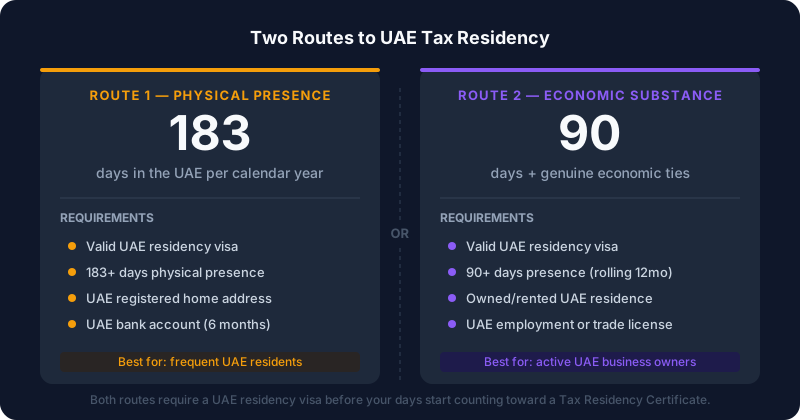
UAE tax residency can be established via two routes, each with different day requirements.
Route 1: The 183-Day Rule
The primary test. If you spend 183 or more days in the UAE during a calendar year, you qualify as a UAE tax resident for that year.
Days are counted based on physical presence — any day (or part of a day) spent in the UAE counts. There is no distinction between working days and personal days.
Practical consideration: 183 days is just over 6 months. For someone who also needs to maintain ties elsewhere (family, business meetings, other trips), actually spending 183 days in the UAE requires planning. Using a Tax Residency Calculator to track your UAE days in real time is essential — accidentally falling to 182 days can mean your TRC application is rejected.
Route 2: The 90-Day Rule (with Economic Substance)
The alternative test allows UAE tax residency after just 90 days of physical presence, provided you also demonstrate genuine economic substance in the UAE:
- A permanent residence in the UAE — either owned or rented. A hotel room does not qualify.
- Financial interests or work in the UAE — employment by a UAE company, a UAE trade license for your business, directorships of UAE entities, or other economic activities within the UAE
This route is designed for people who have real business or investment activity in the UAE but cannot always spend 183 days per year there (frequent travelers, people with business obligations elsewhere).
Important: For the 90-day route, "90 days" means days during any 12-month period — not necessarily a calendar year. The FTA may assess presence across a rolling window.
UAE Residency Visa: The Prerequisite
Before you can apply for a UAE Tax Residency Certificate, you must hold a valid UAE residency visa. UAE tax residency and UAE immigration residency are separate concepts, but you need the latter to get the former.
Main routes to a UAE residency visa:
Employment Visa
The most common route. A UAE-based employer sponsors your visa. You receive a 2–3 year renewable residence permit.
Investor / Business Owner Visa
If you establish a UAE company (mainland or free zone), you can sponsor yourself for a residency visa as the company's owner or director. Free zone companies (in DIFC, ADGM, Dubai Internet City, etc.) are particularly popular with international entrepreneurs.
UAE Golden Visa
A long-term residency visa (5 or 10 years) available to investors, entrepreneurs, specialized talent, and exceptional students. Investment routes require a minimum AED 2 million investment in UAE real estate or public investments. Once granted, the Golden Visa does not require employer sponsorship.
Key for tax purposes: The Golden Visa's longer validity (10 years) makes it particularly useful for long-term UAE tax planning — you don't need to worry about visa renewals affecting your residency status.
Freelancer / Talent Visa
UAE free zones offer freelancer licenses, which can support a residency visa application. Popular for independent contractors working for international clients.
Economic Substance: What the UAE Actually Requires
The 2023 update to the UAE's tax residency framework introduced clearer economic substance requirements. Simply holding a UAE residency visa and spending enough days in the country is the baseline — but the FTA also looks at whether your UAE presence reflects genuine economic activity.
For the TRC application, you typically need to provide:
- Proof of physical presence — entry/exit stamps, flight records, or a day-by-day presence log. The FTA has access to UAE border control data.
- Proof of UAE residence — a tenancy contract (Ejari registration) or property ownership documents. Your UAE address must be a genuine, habitable home — not a registered address service.
- Proof of economic activity — employment contract, trade license, company registration, or other evidence that you have economic ties to the UAE beyond simply being present.
- Bank statements — a UAE bank account with regular activity. The FTA looks for genuine financial integration, not a dormant account.
The FTA has tightened its criteria over recent years in response to pressure from the OECD and partner countries under the Common Reporting Standard. A TRC issued solely on the basis of day-counting without genuine economic substance is less defensible than one with all the boxes ticked.
How to Apply for a UAE Tax Residency Certificate
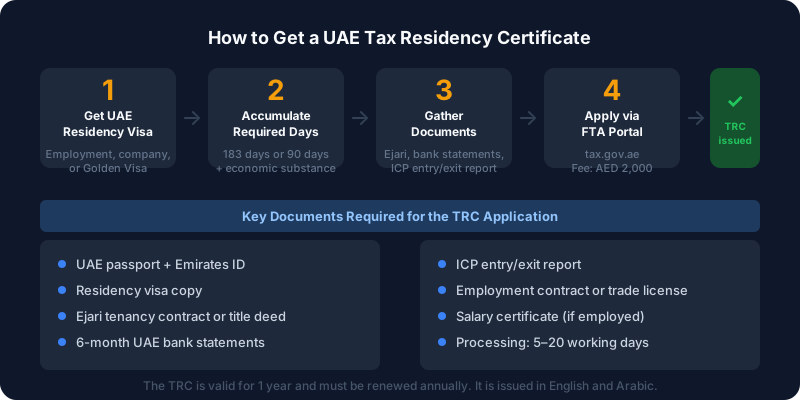
Step 1: Ensure you meet the requirements
- Hold a valid UAE residency visa
- Have spent 183+ days (or 90+ days with economic substance) in the UAE in the relevant period
- Have a UAE bank account and a registered UAE address
- Have documents showing economic activity in the UAE
Step 2: Register on the FTA portal
Create an account at the Federal Tax Authority online portal (tax.gov.ae). Individual applicants apply through the TRC section.
Step 3: Submit your application with supporting documents
Required documents typically include:
- Copy of UAE passport / Emirates ID
- Copy of your residency visa
- Tenancy contract (Ejari registered) or title deed
- 6-month bank statement from a UAE bank
- Entry/exit report from the UAE immigration authority (obtainable online via ICP — the Federal Authority for Identity and Citizenship)
- Employment contract or trade license (depending on your economic activity)
- Salary certificates or invoices if self-employed
Step 4: Pay the fee and await approval
The FTA TRC application fee is AED 2,000 for individuals. Processing typically takes 5–20 working days.
Step 5: Receive your TRC
The certificate is issued in both Arabic and English and specifies the validity period (usually 1 year). It is stamped and signed by the FTA and is accepted by UAE treaty partner countries.
UAE Double Taxation Treaties
The UAE has a network of over 130 double taxation treaties — one of the largest in the world. These treaties matter because they determine whether your home country must give up its taxing rights over you once you are a UAE tax resident.
Key treaty partners include:
- Most EU member states (Germany, France, Italy, Netherlands, Spain, etc.)
- UK, Switzerland, Norway
- India, Pakistan, China, Japan, Singapore
- South Africa, Egypt, Morocco
Important gap: The UAE does not have a tax treaty with the United States. US citizens moving to the UAE remain subject to US taxation on worldwide income (the US taxes based on citizenship, not residency) — a UAE TRC provides no relief from US tax obligations.
Also note: The UAE does not currently have a tax treaty with Canada, Australia, or New Zealand. Residents of those countries moving to the UAE need to demonstrate their tax exit through their home country's domestic rules rather than relying on a treaty tie-breaker.
What Your Home Country Thinks of UAE Residency
A UAE TRC confirms your UAE tax residency under UAE law. Whether your home country accepts that you've left is a separate question, governed by your home country's domestic rules.
Common challenges:
Germany: Accepting UAE tax residency is generally straightforward if you've properly deregistered (Abmeldung) and no longer have a home available to you in Germany. Germany has a tax treaty with the UAE. However, Germany also applies an anti-avoidance rule for moves to low-tax jurisdictions — if you're still doing business in Germany, the German tax authority may argue you have a permanent establishment there.
UK: UK residency exit is governed by the Statutory Residence Test. If you retain UK ties (a UK home, UK family, UK work days) the SRT may keep you UK-resident despite your UAE presence. The UK and UAE have a tax treaty, but the SRT takes priority over the treaty's tie-breaker rules in some scenarios.
France: France has an anti-avoidance provision specifically targeting moves to low-tax countries. If you cannot demonstrate a genuine economic or professional reason for relocating to the UAE (beyond the tax savings), France may challenge the exit.
Australia: Australia's "resides" test and the difficulty of clearly establishing a domicile outside Australia make UAE exits complex. Engage a specialist before relying on UAE residency to escape Australian tax obligations.
Common Mistakes
1. Counting tourist days toward the residency threshold. Days spent in the UAE before you held a residency visa typically do not count toward your day total for TRC purposes. Get your visa first, then start counting.
2. Renting an address service rather than a genuine home. The FTA requires a real Ejari-registered tenancy contract. A registered office address or business center address is not sufficient for the personal TRC.
3. Not obtaining an entry/exit report. This is one of the key documents the FTA requires to verify your physical presence. Many applicants don't know it's needed and have to scramble to get it. Request it early through the ICP portal.
4. Maintaining too many home-country ties. A UAE TRC doesn't automatically cancel your home country's claim on you. If you're still maintaining a home in Germany, spending 90 days there, and managing German clients, Germany may argue you remain German-resident despite your UAE presence.
5. Applying in the wrong entity. If your income flows through a company, the company's tax residency is separate from your personal residency. A personal TRC does not cover corporate income — and the UAE corporate tax may apply at the company level.
Frequently Asked Questions
Can I establish UAE tax residency as a freelancer with no UAE clients?
Yes — the UAE does not require your income to be UAE-sourced. You can work entirely for foreign clients and still be a UAE tax resident, provided you meet the physical presence and economic substance requirements (UAE visa, UAE home, UAE bank account, UAE trade license or free zone company).
Does the UAE share financial data with other countries under CRS?
Yes. The UAE joined the Common Reporting Standard and began automatic exchange of financial account information with partner countries. If you have a UAE bank account, your home country's tax authority may receive information about it. This is why proper tax exit from your home country is essential — not just obtaining a UAE TRC.
How long does it take to set up UAE residency from scratch?
For most people: 4–8 weeks from arrival to having a residency visa and Emirates ID. Obtaining a TRC after that requires accumulating sufficient days and documents — realistically 6–9 months after first arrival if going for the 183-day route.
What happens if I spend fewer than 183 days in the UAE in a given year?
If you drop below 183 days without qualifying under the 90-day economic substance route, you may not qualify for a TRC for that year. Track your days carefully using a Tax Residency Calculator — falling one day short can have significant consequences.
Is the UAE suitable for US citizens trying to reduce their tax burden?
Partially. US citizens can benefit from the UAE's 0% personal income tax in combination with the Foreign Earned Income Exclusion (FEIE) — which excludes up to ~$126,500 (2024) of foreign earned income from US tax. But US citizens never fully escape US taxation unless they renounce citizenship.
Summary
UAE tax residency offers genuine 0% personal income tax — but obtaining and defending it requires more than just buying a visa and spending time in Dubai.
- Two routes: 183+ days of physical presence, or 90+ days with genuine economic substance in the UAE
- You must hold a UAE residency visa before your days count toward TRC qualification
- The Tax Residency Certificate (TRC) is issued by the Federal Tax Authority — apply after meeting the day and substance requirements
- The UAE has 130+ tax treaties, but notably excludes the US, Canada, Australia, and New Zealand
- Your home country's exit rules are an entirely separate consideration — a UAE TRC doesn't automatically mean your home country accepts you've left
- Track your UAE days precisely from day one — missing the 183-day threshold by even one day can invalidate a TRC application