
Thailand Tax Residency in 2026: The 180-Day Rule and Foreign Income Taxation
Thailand has long been one of the world's most popular bases for digital nomads and expats — affordable, well-connected, with a thriving international community in Chiang Mai, Bangkok, and beyond. For years, it was also considered a tax-favorable destination: Thailand taxed only income earned in Thailand, and only income remitted to Thailand in the same year it was earned.
That changed in 2024.
A Revenue Department ruling that took effect from January 1, 2024 altered how Thailand taxes foreign-sourced income — and the implications for long-term expats and nomads using Thailand as a base are significant. If you're spending significant time in Thailand, or considering it as your primary base, you need to understand the current rules.
This guide explains Thailand's tax residency test, the 180-day rule, what the 2024 changes mean, and what Thailand's LTR visa actually offers in terms of tax benefits.

Thailand's Tax Residency Test
Thailand has a relatively simple residency test: if you spend 180 days or more in Thailand in a calendar year (January 1–December 31), you are a Thai tax resident.
The 180-day threshold (not 183) applies to any calendar year. Days are counted based on physical presence — any day or part of a day spent in Thailand counts.
There is no additional test. Unlike the UK (which has the Statutory Residence Test) or Australia (which uses a "resides" analysis), Thailand's test is purely mechanical: 180 days in, you're resident. Under 180 days, you're not.
What residency means: Thai tax residents are taxed on income arising from sources in Thailand, and — following the 2024 rule change — on foreign-sourced income under the new remittance rules described below.
Non-residents: Thai non-residents are taxed only on income arising from sources within Thailand.
The 2024 Rule Change: Foreign Income Is Now Taxable
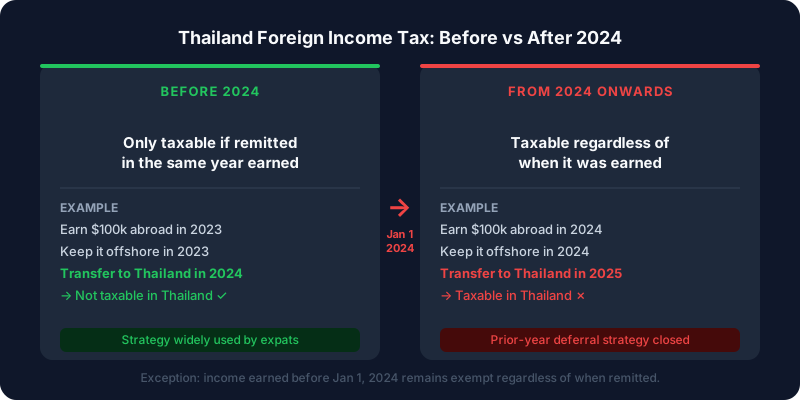
Before 2024, Thailand operated on a modified territorial basis for residents. The key rule was:
Foreign-sourced income was taxable in Thailand only if it was remitted to Thailand in the same tax year it was earned.
This created a widely-used planning approach: earn foreign income in Year 1, keep it offshore, remit it to Thailand in Year 2. Since the income was earned in a different tax year from the year it was remitted, it was not taxable in Thailand.
That loophole closed on January 1, 2024.
The Revenue Department issued Departmental Instruction No. P.161/2566 in September 2023, effective from January 1, 2024, which changed the rule to:
Foreign-sourced income remitted to Thailand is taxable in Thailand regardless of whether it was earned in the current year or a prior year.
What this means in practice:
- If you are a Thai tax resident (180+ days in Thailand) and you transfer money from abroad to Thailand — savings, investment gains, income from prior years, anything — that remittance may be taxable in Thailand
- The prior-year deferral strategy no longer works
- Foreign income you earned before January 1, 2024 is explicitly exempt — only income earned from 2024 onwards falls under the new rules
This is a significant shift. Thailand is moving toward a more comprehensive residency-based tax system, at least for residents who remit foreign funds.
What Income Is Now Taxable for Thai Residents?
Under the current rules (post-2024), Thai tax residents must include in their assessable income:
- Foreign employment income remitted to Thailand (salary from foreign employers)
- Foreign business income remitted to Thailand (freelance income, consulting, trading profits)
- Capital gains from foreign assets remitted to Thailand (investment gains, crypto, property sales)
- Rental income from foreign properties remitted to Thailand
- Dividends and interest from foreign sources remitted to Thailand
Key principle: The taxable event is the remittance to Thailand — not the earning. If you earn foreign income and keep it in a foreign bank account and never transfer it to Thailand, it is not assessable in Thailand.
The practical implication: Living in Thailand while keeping all foreign income offshore is still possible — but you would need to fund your Thai living expenses from a source other than taxable foreign income. In practice, for most people spending 180+ days in Thailand, meaningful amounts of money are being transferred to Thailand, and those transfers are now taxable.
Thai Personal Income Tax Rates
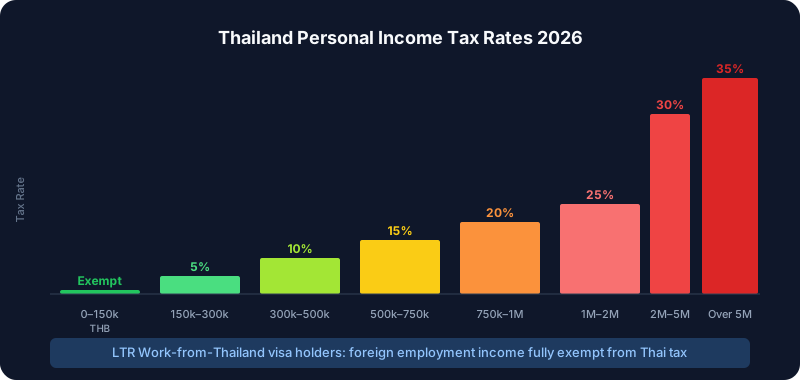
Thai personal income tax is progressive. For Thai residents, the rates for 2026 are:
| Taxable income (THB) | Rate |
|---|---|
| 0 – 150,000 | Exempt |
| 150,001 – 300,000 | 5% |
| 300,001 – 500,000 | 10% |
| 500,001 – 750,000 | 15% |
| 750,001 – 1,000,000 | 20% |
| 1,000,001 – 2,000,000 | 25% |
| 2,000,001 – 5,000,000 | 30% |
| Over 5,000,000 | 35% |
The top rate of 35% kicks in at approximately USD 140,000 at current exchange rates. For lower incomes, Thai rates are competitive with European standards — but Thailand is no longer the zero-tax destination it was informally treated as.
Deductions: Thailand allows personal deductions (personal allowance, spouse allowance, dependent deductions) and expense deductions (employment expense allowance of 50% of income up to THB 100,000). These reduce the effective tax rate meaningfully at lower income levels.
Thailand's LTR Visa: The Tax Benefit That Survived
In September 2022, Thailand introduced the Long-Term Resident (LTR) Visa — a 10-year visa designed for wealthy individuals, pensioners, remote workers, and high-skilled professionals.
One of the LTR visa's explicitly stated benefits is a specific tax treatment:
LTR visa holders who qualify under the Work-from-Thailand (WFT) category — employed by foreign companies and working remotely from Thailand — have their foreign-sourced employment income exempt from Thai personal income tax.
This exemption was specifically reaffirmed after the 2024 rule change. The Revenue Department confirmed that qualifying LTR WFT visa holders are exempt from the new foreign income remittance taxation.
Who qualifies for the LTR Work-from-Thailand category:
- Employed by a foreign-registered company (not a Thai company)
- Annual income of at least USD 80,000 (or USD 40,000 with a master's degree, specific certifications, or 5 years' experience in a qualifying field)
- The foreign employer must have been in operation for at least 3 years
- Proof of at least 3 years of employment or consistent income
The LTR visa tax exemption in practice: A software developer earning USD 120,000/year from a US tech company, living in Bangkok on an LTR visa, can potentially pay zero Thai income tax on that foreign income even while remitting it to Thailand. This makes the LTR visa the primary tax-efficient path to long-term Thailand residency for digital workers.
For Nomads Staying Under 180 Days
If you stay fewer than 180 days in Thailand in a calendar year, you are not a Thai tax resident. Non-residents are taxed only on income arising within Thailand — salary from a Thai employer, income from Thai business activity, Thai rental income.
For a nomad earning from foreign clients and staying fewer than 180 days, Thai tax obligations are effectively zero on that foreign income.
The practical challenge: Many people who consider Thailand their "base" actually spend more than 180 days there without tracking carefully. A visa run to Malaysia or Laos for a long weekend doesn't reset your day count in any meaningful way if you're back in Bangkok two days later.
Use a Tax Residency Calculator to monitor your Thailand days across the calendar year. If you're approaching 180 days and haven't established an LTR or other qualifying status, consider a longer trip elsewhere to stay under the threshold.
Thailand's Double Taxation Treaties
Thailand has double taxation treaties with over 60 countries, including:
- Most European countries (Germany, France, UK, Netherlands, Sweden, etc.)
- USA, Canada, Australia
- Japan, China, India, Singapore, Hong Kong
These treaties determine which country has primary taxing rights when you have income from or connections to both Thailand and another country. For most employment income earned by Thai residents from foreign sources, the treaties typically allocate taxing rights to the country where work is performed — which, for remote workers in Thailand, would be Thailand.
This is an area where the 2024 changes intersect with treaty obligations in ways that are not yet fully settled in practice. If you're relying on a treaty to avoid double taxation, specialist advice is warranted.
Filing Requirements for Thai Residents
Thai tax residents with assessable income must file an annual income tax return (PND.90 or PND.91) by March 31 of the following year.
PND.91 is for individuals with only employment income.
PND.90 is for individuals with business income, rental income, investment income, or multiple income sources.
The Thai Revenue Department is increasing enforcement of filing requirements for foreigners. Non-filing penalties include surcharges and potential criminal liability for deliberate tax evasion.
If you are a Thai resident with foreign income that is remitted to Thailand, you should file even if you believe a treaty reduces your liability to zero — the filing requirement and the tax liability are separate obligations.
Common Questions About Thailand and Tax in 2026
I've been living in Thailand for years under the old rules. Do I need to do anything different?
Yes. From January 1, 2024, the prior-year foreign income deferral strategy no longer applies. Any foreign income earned from 2024 onwards that you remit to Thailand is potentially taxable. You should assess your situation and consider whether the LTR visa makes sense, or whether you should adjust your remittance patterns.
Is crypto income affected by the 2024 rules?
The Thai Revenue Department has specifically indicated that capital gains from cryptocurrency are assessable income under Thai law. If you are a Thai tax resident and you sell crypto at a gain, and remit those proceeds to Thailand, that gain is taxable at progressive rates. The pre-2024 deferral strategy also applied to crypto gains — that option is now gone.
Does the 180-day test use calendar days or nights?
Calendar days — any day (or part of a day) spent in Thailand counts. If you fly in on December 31, that's one day in Thailand for that calendar year. If you're counting carefully, this can matter.
What if I'm between Thailand and another country — say, 160 days in Thailand and 120 days in Singapore?
At 160 days in Thailand, you are not a Thai tax resident. Singapore would assess you under its own 183-day test — at 120 days, you would also not be a Singapore tax resident. You may not be tax resident anywhere, which creates its own complications (no foreign tax residency certificate, potential continued liability at home). Use a multi-country day tracker to monitor all thresholds simultaneously.
Summary
Thailand remains one of the world's most livable expat destinations — but its tax position in 2026 is materially different from what it was before 2024.
- Thai tax residency is triggered at 180 days in a calendar year (not 183)
- From January 1, 2024, foreign income remitted to Thailand is taxable regardless of when it was earned — the prior-year deferral strategy no longer works
- Thai personal income tax rates are progressive up to 35% — similar to many European countries at higher income levels
- The LTR Work-from-Thailand visa provides an explicit foreign income tax exemption for qualifying remote workers earning from foreign employers — this is the primary tax-efficient path to long-term Thailand residency
- Staying under 180 days keeps you out of the Thai tax system entirely (subject to your home country's rules)
- Track your Thailand days carefully — the 180-day threshold is lower than most countries, and many long-term expats exceed it without realizing