
How to Get a Tax Residency Certificate: What It Is, Who Needs One, and How to Get It
You've established residency in a new country. You've spent the required days there, opened a bank account, signed a lease, and registered with local authorities. Now your home country's tax authority is asking for proof that you've actually left their tax system. Or your bank has sent you a form demanding to know your tax residency. Or you're trying to claim the benefits of a double taxation treaty.
In all these situations, what you need is a tax residency certificate — sometimes called a certificate of tax residence, a tax domicile certificate, or a certificate of fiscal residence.

This guide explains exactly what a tax residency certificate is, why you need one, and how to obtain it in the major jurisdictions where mobile professionals and expats tend to establish themselves.
What Is a Tax Residency Certificate?
A tax residency certificate (TRC) is an official document issued by a country's tax authority confirming that you are — or were, during a specified period — a tax resident of that country.
It typically states:
- Your full name and identification number
- The period of residency being certified (often a calendar year)
- The country issuing the certificate
- A confirmation that you are subject to tax in that country in your capacity as a resident
It does not state how much tax you've paid, what your income is, or whether you owe any outstanding amounts. It is purely a confirmation of residency status.
Why You Need a Tax Residency Certificate
A TRC is required in several common situations:
1. Claiming double taxation treaty benefits
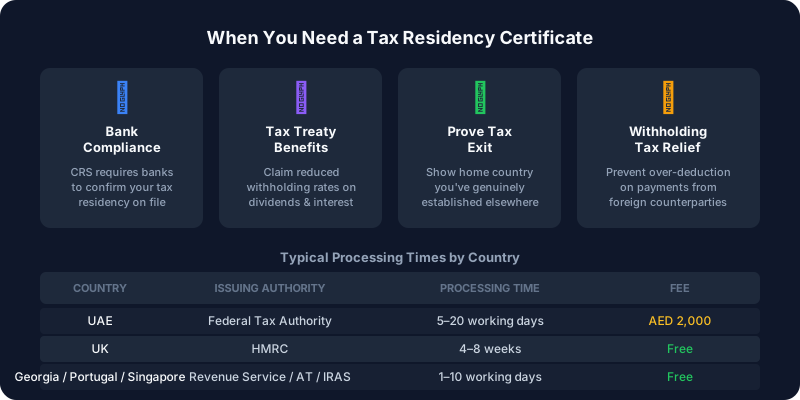
Most double taxation treaties require you to prove you are a resident of the treaty partner country to claim reduced withholding tax rates, exemptions, or other treaty protections. The standard proof is a TRC. Without it, the counterparty (your bank, employer, or foreign tax authority) will default to applying full withholding rates.
2. Demonstrating exit to your home country
When you leave a country's tax system, the home country's tax authority will often want evidence that you've established genuine residency elsewhere. A TRC from your new country — issued by an official government authority — is the strongest evidence available.
3. CRS and banking compliance
Under the Common Reporting Standard (CRS), banks are required to determine and record the tax residency of all account holders. When a bank asks you to confirm your tax residency and you claim a country other than the one where you're banking, they will typically ask for a TRC or equivalent documentation.
4. Receiving payments without excessive withholding
Many countries apply withholding tax to payments made to foreign recipients — interest, dividends, royalties, service fees. If you are a resident of a country with a tax treaty that reduces or eliminates that withholding rate, you need a TRC to claim the reduced rate.
5. Visa and immigration applications
Some countries' immigration authorities ask for proof of your tax residency as part of visa or residency applications — particularly for investment visas, long-stay permits, and citizenship applications.
When to Apply
The general principle is: apply as soon as you qualify. Don't wait until you're in an urgent situation (a bank demanding documentation, a tax authority questioning your exit) to start the process.
For most countries, a TRC is issued for a specific calendar year or period — not perpetually. You may need to renew it each year. This means:
- For your first year in a new country: Apply as soon as you've met the residency threshold (usually after 183 days, or at the end of the calendar year)
- For ongoing residency: Apply annually, typically in the first quarter of the following year
- For retroactive purposes: Many tax authorities will issue TRCs for prior years, provided you can demonstrate that residency requirements were met during that period
How to Get a Tax Residency Certificate: Country by Country
United Arab Emirates (UAE)
The UAE issues TRCs through the Federal Tax Authority (FTA).
Requirements:
- Valid UAE residency visa
- Physical presence of 183+ days (or 90+ days with economic substance)
- UAE bank account (with 6 months of statements)
- UAE residential address (Ejari-registered tenancy contract or title deed)
- Entry/exit report from ICP (UAE immigration)
- Employment contract, trade license, or other evidence of economic activity
Process:
- Register on the FTA portal (tax.gov.ae)
- Submit application with all supporting documents
- Pay AED 2,000 fee
- Receive TRC within 5–20 working days
Validity: Typically 1 year. Issued in English and Arabic.
Georgia
The Georgian Revenue Service issues TRCs as a standard service.
Requirements:
- Georgian TIN (tax identification number)
- Evidence of 183+ days of physical presence in Georgia
- Optionally: proof of residential address, bank account, or other ties to Georgia
Process:
- Submit an application at a Georgian Revenue Service office or online via the Revenue Service portal
- Provide passport details and Georgian TIN
- The certificate is typically issued within a few days
Cost: Low (nominal administrative fee or free in many cases)
Validity: Usually issued for a calendar year.
Portugal
The Portuguese Tax Authority (Autoridade Tributária e Aduaneira) issues TRCs through the Portal das Finanças.
Requirements:
- Portuguese NIF (tax identification number)
- Portuguese fiscal address registered with the tax authority
- Evidence of meeting residency requirements (183+ days or habitual residence)
Process:
- Log in to Portal das Finanças (portaldasfinancas.gov.pt)
- Navigate to Certidões → Pedido de Certidão
- Select "Residência Fiscal" certificate
- The certificate is usually generated automatically or within a few business days
Cost: Free or nominal fee
Validity: Issued for a specified period (calendar year or specific dates).
Cyprus
The Cyprus Tax Department issues TRCs (officially called "Certificate of Tax Residency").
Requirements:
- Cyprus Tax Identification Code (TIC)
- Evidence of Cyprus residency — either 183+ days physical presence, or the 60-day rule (60 days + economic ties + no other residency)
- Proof of Cyprus address and local economic activity
Process:
- Submit form TD78 to the Cyprus Tax Department
- Attach supporting documentation
- Certificate is issued typically within a few weeks
Cost: Nominal fee (EUR 30–50 approximately)
Germany
The German Federal Central Tax Office (Bundeszentralamt für Steuern) issues residence certificates for international use.
Requirements:
- German tax identification number (Steueridentifikationsnummer)
- Evidence of German tax residency (registration at a German address, tax filing)
Process:
- Submit Form 017 (Application for a Certificate of Residence for German Tax Purposes) to the Bundeszentralamt für Steuern, or apply through your local Finanzamt
- Specify the purpose (which country/treaty you need the certificate for)
- Certificate is issued within a few weeks
Note: Germany issues TRCs for specific treaties or general purposes. If you need a German TRC to present to a specific country's tax authority, specify that country in the application.
United Kingdom
HMRC issues a "Certificate of Residence" (CoR).
Requirements:
- UK National Insurance number or Unique Taxpayer Reference (UTR)
- Evidence of UK tax residency (meeting the Statutory Residence Test)
- Reason for requesting the certificate (which country and which treaty clause)
Process:
- Apply using HMRC's online form (gov.uk/guidance/certificate-of-residence)
- Alternatively, write to HMRC's Non-Resident Landlords Scheme or relevant HMRC office
- Specify the country you are presenting the certificate to and the treaty article
Processing time: Typically 4–8 weeks
Note: HMRC issues UK CoRs only when there is a specific purpose — they are not issued as general documentation. You must state the country and reason for which the certificate is needed.
Singapore
The Inland Revenue Authority of Singapore (IRAS) issues Certificates of Residence (COR).
Requirements:
- Singapore tax reference number
- Evidence of Singapore tax residency (183+ days in Singapore, or employment in Singapore for the period)
- Business reason for the certificate (which country and treaty)
Process:
- Apply online through the IRAS myTax Portal
- Specify the country and treaty for which the certificate is needed
- Certificate is usually issued within 7 working days
Cost: Free
Thailand
The Thai Revenue Department issues TRCs.
Requirements:
- Thai tax identification number (TIN)
- Evidence of Thai tax residency (180+ days in Thailand in the relevant year)
- Completed application form
Process:
- Apply at the Revenue Department district office in your area in Thailand
- Provide your TIN, passport, and evidence of residency
- Processing time varies by office — typically 1–4 weeks
What Supporting Documents You'll Typically Need
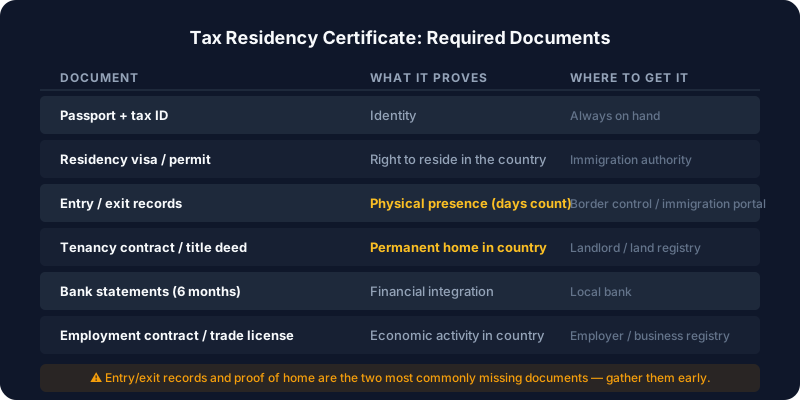
Regardless of country, TRC applications almost always require some combination of the following. Gathering these in advance makes the process significantly faster:
| Document type | What it demonstrates |
|---|---|
| Passport copies | Identity and travel history |
| Entry/exit records | Physical presence in the country |
| Tenancy contract / title deed | Permanent home in the country |
| Bank account statements (6 months) | Financial integration |
| Employment contract / trade license | Economic activity |
| Utility bills in your name | Habitual residence |
| Tax registration confirmation | Formal registration with local tax authority |
| Prior year tax return (if filed) | Ongoing compliance |
Pro tip: Keep all of these documents organized and up to date on an ongoing basis — not just when you need a TRC. The documents you need for a TRC are the same documents you'd need to defend your residency status in an audit.
Common Problems and How to Avoid Them
Problem: The certificate covers a different period than what you need
TRCs are typically issued for a specific year or period. If you need to demonstrate residency spanning two calendar years, you may need two separate certificates.
Problem: Your new country issues a TRC before your old country accepts it
Some home countries require specific language or format in a foreign TRC to accept it. For example, the UK's HMRC has specific requirements for what a foreign TRC must say to be accepted. Check what your home country's tax authority requires before applying.
Problem: Long processing delays
Some countries' tax authorities take weeks or months to process TRC applications. Apply early — especially if you need the certificate for a tax filing deadline in another country.
Problem: You don't yet meet the requirements for a TRC
If you've moved to a new country mid-year and haven't yet spent 183 days there, you may not qualify for a TRC yet. This is a genuine gap period — you may not be resident anywhere for part of the year, which has its own implications.
Problem: Your day count is wrong
The most common reason a TRC application fails or is challenged is inaccurate day-count records. Maintaining a precise, documented record of your entries and exits — using a Tax Residency Calculator that tracks days across multiple countries — is the foundation of any TRC application.
TRC vs. Tax Clearance Certificate
These are different documents that often get confused:
- Tax Residency Certificate (TRC): Confirms that you are (or were) a tax resident of a country. Says nothing about whether you owe any tax.
- Tax Clearance Certificate: Confirms that you have no outstanding tax liabilities in a country. Used when closing a business, emigrating, or applying for certain licenses or contracts.
Some countries — particularly South Africa and India — require a tax clearance certificate as part of the process of formally ceasing residency. A TRC from your new country does not substitute for a tax clearance from your old country.
Frequently Asked Questions
Can I have a TRC from two countries simultaneously?
Yes — you can be a tax resident of two countries simultaneously (dual residency), and both can issue TRCs. This is exactly the situation that tax treaties are designed to resolve through tie-breaker rules. Having a TRC from Country B doesn't automatically cancel Country A's TRC or taxing rights.
Is a TRC the same as a certificate of domicile?
Not always. "Domicile" is a separate legal concept from "tax residency" in some jurisdictions (notably the UK). A certificate of tax residence and a certificate of domicile are distinct documents in countries where that distinction matters.
Do I need a TRC to open a bank account in another country?
Not always — a TRC is useful but not always required. Banks typically accept a range of documents to establish tax residency for CRS purposes, including utility bills, lease agreements, and tax registration confirmations. A TRC is the clearest and most widely accepted, but alternatives often exist.
How long is a TRC valid?
Most TRCs are issued for a specific year or period and need to be renewed annually. Some countries issue rolling or multi-year certificates. Check the validity period on the specific certificate when you receive it.
Summary
A tax residency certificate is not optional for anyone seriously managing their international tax position. It is the foundational document for invoking treaty benefits, demonstrating exit from your home country's tax system, and satisfying banking compliance requirements.
- A TRC is issued by your new country's tax authority confirming your residency there
- It is required to invoke double taxation treaties, demonstrate tax exit, and satisfy CRS banking requirements
- Every country has its own application process — the UAE, Georgia, Portugal, Cyprus, UK, and Singapore all have distinct procedures
- The key input to any TRC application is an accurate record of your physical presence — which requires careful day tracking from the moment you arrive in a new country
- Apply as soon as you meet the requirements — don't wait for an urgent situation
Start tracking your days before you need to prove them. A Tax Residency Calculator that logs your country-by-country day count creates the paper trail that makes TRC applications straightforward.