
Portugal Tax Residency in 2026: NHR, IFICI (NHR 2.0), and the 183-Day Rule
Portugal has spent the past decade building one of the world's most attractive ecosystems for mobile professionals, remote workers, and retirees. The combination of an agreeable climate, EU membership, English-speaking infrastructure, and — critically — a favorable tax regime for new residents turned Lisbon and Porto into global expat hubs.
The original Non-Habitual Resident (NHR) regime, which ran from 2009 to 2023, was the headline reason many people chose Portugal. It's now closed to new applicants. But Portugal didn't simply abolish NHR — it replaced it with a new scheme, the IFICI regime (sometimes called NHR 2.0), which launched in 2024.
This guide explains the full picture: how Portuguese tax residency works, how the 183-day rule applies, who can qualify under IFICI, and what you should know before making Portugal your base.

How Portuguese Tax Residency Works
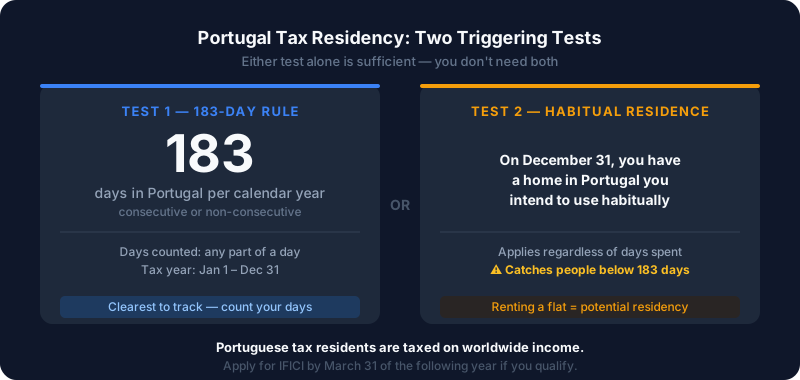
Portugal determines tax residency using two main tests, either of which is sufficient:
1. The 183-day test: If you spend 183 or more days in Portugal in a calendar year — consecutive or not — you are a Portuguese tax resident for that year.
2. The habitual residence test: If on December 31 of a given year you have a home in Portugal that you intend to use as your habitual residence, you are a Portuguese tax resident for that year — regardless of how many days you've spent there.
The habitual residence test is the one that catches people off guard. You don't need to spend 183 days in Portugal to become a Portuguese tax resident. If you buy or rent a flat in Lisbon and it's your main base, Portugal can claim you as a resident from the moment that home is available to you.
Tax year: Portugal uses the calendar year (January 1–December 31).
Worldwide taxation: Portuguese tax residents are taxed on worldwide income. Non-residents are taxed only on Portuguese-sourced income.
Standard income tax rates: Portugal has a progressive income tax scale reaching 48% for income above €80,000, with a solidarity surcharge of 2.5%–5% on higher incomes. Without a special regime, Portugal is not a low-tax country.
The Original NHR Regime (2009–2023)
To understand what changed and why it matters, you need to know what the original NHR offered.
The Non-Habitual Resident regime was available to anyone who:
- Became a Portuguese tax resident
- Had not been a Portuguese tax resident in the previous 5 years
- Applied within the deadline (by March 31 of the year following the year of first residency)
Qualified NHR holders received, for 10 years:
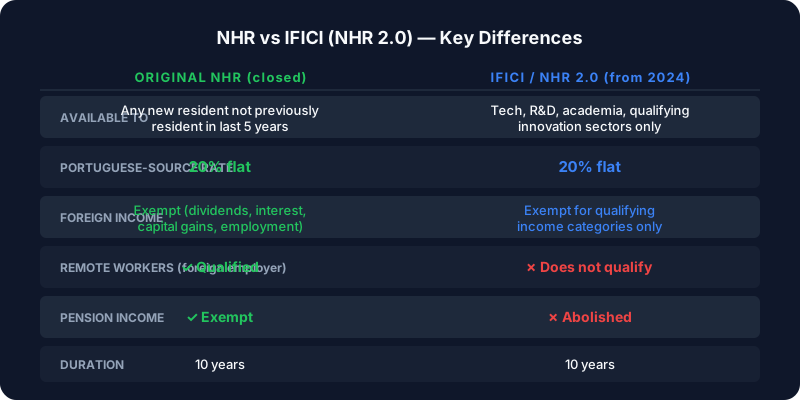
- A flat 20% rate on Portuguese-sourced income from "high value-added" activities (technology, finance, medicine, engineering, etc.)
- Exemption from Portuguese tax on most categories of foreign-sourced income (dividends, interest, capital gains, rental income, employment income, pension income) — provided they were taxable in the source country under that country's domestic law or a tax treaty
The foreign income exemption was the key benefit. A freelancer earning €150,000/year from foreign clients, established as an NHR, could potentially pay zero Portuguese income tax on that income (if the source country had taxing rights under a treaty).
The original NHR was closed to new applicants from January 1, 2024.
People already registered as NHR before that date retain their status for the remainder of their 10-year period. There is also a transitional provision: people who had already become Portuguese tax residents (or who had signed a binding employment contract to work in Portugal) before December 31, 2023 could apply for NHR under the original rules until March 31, 2024.
The IFICI Regime (NHR 2.0): What It Is and Who Qualifies
The IFICI (Incentivo Fiscal à Investigação Científica e Inovação — Fiscal Incentive for Scientific Research and Innovation) is the successor to NHR. It was introduced in the 2024 Portuguese State Budget and applies to individuals who first become Portuguese tax residents from 2024 onwards.
Key benefit
20% flat rate on employment income and self-employment income arising in Portugal from qualifying activities. Foreign-sourced income of the same categories is exempt from Portuguese tax.
This mirrors the original NHR's Portuguese-source rate, but the income categories that qualify are considerably more restricted.
Who qualifies for IFICI
The IFICI regime is explicitly targeted at the following categories:
Category A — Scientific research and innovation:
- Researchers and PhD-holders working in R&D activities
- Highly qualified professionals in technology, engineering, and natural sciences with recognized qualifications
Category B — Higher education and academic activities:
- Members of academic staff at Portuguese universities
- Qualified researchers at approved Portuguese research centers
Category C — Qualified employment at Portuguese companies:
- Non-habitual residents who take up employment at Portuguese tech companies, startups, and recognized innovation hubs (there is a specific list of qualifying employers and sectors)
Category D — Freelancers and entrepreneurs in qualifying sectors:
- Self-employed professionals in technology, fintech, life sciences, and other designated innovation sectors
- Startup founders and co-founders of qualifying tech companies
Who does NOT qualify
The IFICI regime does not apply to:
- Remote workers employed by foreign companies working from Portugal (this was a major use case under original NHR)
- Retirees and pensioners (the NHR pension exemption was abolished entirely)
- Freelancers in non-qualifying sectors (consulting, marketing, management, etc.)
- Real estate investors and passive income earners (dividends, interest)
This is a substantial narrowing from the original NHR. The IFICI is primarily designed for people working within Portugal's economy in tech and innovation sectors — not for remote workers and digital nomads whose income comes entirely from abroad.
What This Means for Digital Nomads
If you are a digital nomad — working remotely for foreign clients or employers — the IFICI regime likely does not apply to you unless you fall into a specifically qualifying category.
This is a significant change. Under original NHR, a freelancer earning from foreign clients was one of the clearest beneficiaries. Under IFICI, that person would pay standard Portuguese income tax rates (up to 48%) on their foreign income.
Options still available to nomads in Portugal:
Qualify under IFICI Category D. If your freelance work is in tech, software development, data science, cybersecurity, or other designated sectors, you may qualify. The Portuguese tax authority publishes the list of qualifying activities — check whether your professional category is included.
The Non-Habitual Resident transitional application. If you had already established Portuguese tax residency or had a binding employment contract in Portugal before December 31, 2023, you may still have been eligible to apply under the original NHR rules. This window is now closed.
Standard residency without a special regime. Portugal is still a high-quality-of-life EU base, and the standard tax rates — while not low — are manageable compared to Northern European countries. Progressive rates start at 14.5% on income below €7,703 and reach 48% above €80,000.
The D7 Passive Income Visa. For those with passive income (dividends, rental income, pension), the D7 visa grants Portuguese residency. Without NHR, this income is now taxed at standard rates — but the D7 remains a legal, straightforward path to EU residency.
The Digital Nomad Visa
Portugal introduced a Digital Nomad Visa (officially the Visto para Trabalho Remoto) in October 2022. This is a residency visa — not a tax regime.
It grants Portuguese residency to remote workers earning at least 4× Portugal's minimum wage (~€3,480/month gross as of 2024). The visa is available for 1 year (renewable) or as a 2-year residence permit.
Tax implications: Holding a Digital Nomad Visa means you are a Portuguese tax resident. You are taxable on worldwide income at standard Portuguese rates. If you qualify for IFICI, you can apply for that separately. If not, you pay standard progressive rates.
The Digital Nomad Visa is a legal way to live in Portugal — but it is not, on its own, a tax optimization strategy.
The 183-Day Rule in Practice: Common Scenarios
Scenario 1: You spend 6 months in Portugal each year
If you are in Portugal for 183+ days, you are a Portuguese tax resident and pay Portuguese tax on worldwide income. You need to check whether your home country also claims you as a resident (dual residency), and whether a tax treaty applies.
Scenario 2: You spend fewer than 183 days but maintain a flat
If you have a Portuguese flat available to you and Portugal is your habitual base, you are likely a Portuguese tax resident regardless of day count. Portuguese authorities look at the December 31 habitual residence test, not just the 183-day count.
Scenario 3: You split your year between Portugal and another country
If you spend 120 days in Portugal and 100 days in Germany, you may not be a Portuguese tax resident — but you could be a German one. Track your days carefully across both jurisdictions. A Tax Residency Calculator that handles multiple countries simultaneously is essential here.
Scenario 4: You're an NHR holder who moved to Portugal in 2021
Your 10-year NHR period runs through 2030. Your status is unaffected by the IFICI transition — you retain original NHR benefits until your period ends.
How to Establish Portuguese Tax Residency
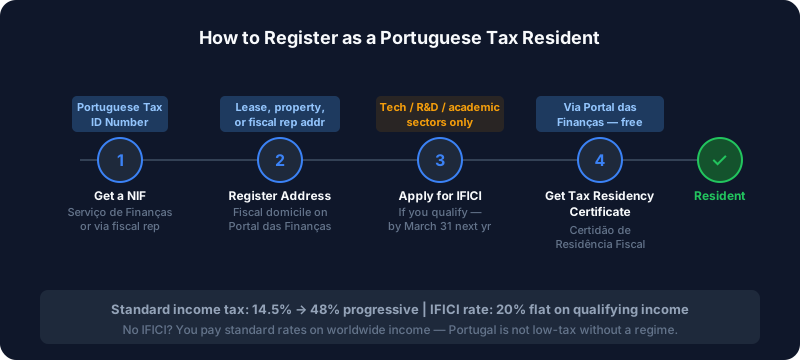
Step 1: Get a NIF (Número de Identificação Fiscal)
This is your Portuguese tax identification number. You can obtain it at a local tax office (Serviço de Finanças) or through a fiscal representative if you're not yet in Portugal.
Step 2: Register your address with the tax authority
You must register a Portuguese address as your fiscal domicile. This can be a rented flat, a purchased property, or (temporarily) a fiscal representative's address.
Step 3: Apply for IFICI if you qualify
Applications must be submitted by March 31 of the year following the year in which you first became a Portuguese tax resident. Submit through the Portal das Finanças (the Portuguese tax portal).
Step 4: Request a tax residency certificate
Once established, you can request a Certificado de Residência Fiscal from the Portuguese tax authority. This is the document you'll need to invoke tax treaties, open foreign bank accounts, and demonstrate your residency status to other tax authorities.
Portugal's Tax Treaty Network
Portugal has double taxation treaties with over 80 countries, including all major EU members, the UK, the US, Canada, Australia, and most of Asia. These treaties determine which country has taxing rights when you have income from or connections to both Portugal and another country.
Under most treaties, Portugal can tax:
- Employment income earned in Portugal
- Business profits with a Portuguese permanent establishment
- Portuguese real estate income
- Portuguese-sourced dividends and interest (often at reduced withholding rates)
For digital nomads working for foreign employers, the treaties often clarify that Portugal does not tax that employment income if the work is genuinely performed in Portugal for a non-Portuguese employer — though this analysis is fact-specific and the IFICI rules have changed the landscape.
Frequently Asked Questions
Is the original NHR still available to anyone?
No. The original NHR is closed to new applicants. People who registered before January 1, 2024 retain their status for the remainder of their 10-year period.
Does IFICI apply to retirees?
No. The pension income exemption that made Portugal popular with retirees (especially from France and the Scandinavian countries) has been abolished. Pension income is now taxed at standard Portuguese rates.
Can I live in Portugal under the Digital Nomad Visa and pay no Portuguese tax?
Not without a qualifying IFICI status. The Digital Nomad Visa grants residency — and residency means Portuguese worldwide income taxation at standard rates.
How does Portugal treat cryptocurrency income?
Crypto held for more than 365 days is generally exempt from Portuguese capital gains tax. Short-term gains (held less than 1 year) are taxed at a flat 28%. This remains one of Portugal's more attractive features for crypto holders.
What happens if I register as an NHR holder in another country after spending time in Portugal?
If you've been a Portuguese tax resident, you cannot register as NHR (or IFICI) in a future period unless you have been absent from Portugal for at least 5 consecutive years. The regime is explicitly for new residents.
Summary
Portugal remains a compelling base for mobile professionals and expats — but the tax picture in 2026 is more nuanced than during the NHR era.
- Portuguese tax residency is triggered at 183+ days OR by having a habitual home in Portugal on December 31
- The original NHR regime is closed to new applicants; existing holders retain their status for the full 10-year period
- IFICI (NHR 2.0) offers a 20% flat rate for qualifying tech, research, and innovation workers — but is significantly more restrictive than NHR
- Digital nomads working for foreign clients without a qualifying IFICI sector will pay standard Portuguese rates (up to 48%)
- The Digital Nomad Visa grants residency, not tax optimization — you need a separate IFICI registration for the favorable rate
- Track your days precisely if you split time between Portugal and other countries — the habitual residence test can trigger residency even below 183 days