
How to Stop Being a Tax Resident: Exit Rules for 15+ Countries (2026 Guide)
Most guides about international taxation focus on where to go — which low-tax country to establish residency in, which special regime to apply for, how many days you need to spend there. Far fewer address the step that comes first: how to actually leave your current tax residency.
This is one of the most consequential mistakes mobile professionals make. You can spend 183 days in the UAE, open a bank account in Georgia, and rent a flat in Lisbon — but if you haven't properly exited your home country's tax system, you likely still owe tax there. On everything you earn. Anywhere in the world.
This guide covers the exit rules for 15+ countries, the common mistakes that leave people unknowingly dual-resident, and what you need to do to actually close the door behind you.

Why "Just Leaving" Doesn't Work
Tax residency is not like a subscription you cancel when you stop using it. Most countries treat you as a tax resident until you take active steps to terminate that status — and in many cases, until you can prove you've established residency somewhere else.
The legal logic is this: if a country cannot point to a new tax residency for you, they often assume you never left. "I was traveling" is not a recognized tax status in most jurisdictions.
This matters because:
- Residency can survive physical absence. Owning property, maintaining a bank account, keeping a registered address, or having family in a country can all maintain tax residency even when you're not there.
- Exit is auditable years later. Tax authorities regularly review residency status retroactively — sometimes 3–5 years after the fact. If your exit wasn't documented properly, you may face back-taxes, interest, and penalties.
- Your new country's residency doesn't automatically cancel the old one. Unless a tax treaty tie-breaker resolves the conflict, you can be a tax resident of two countries simultaneously.
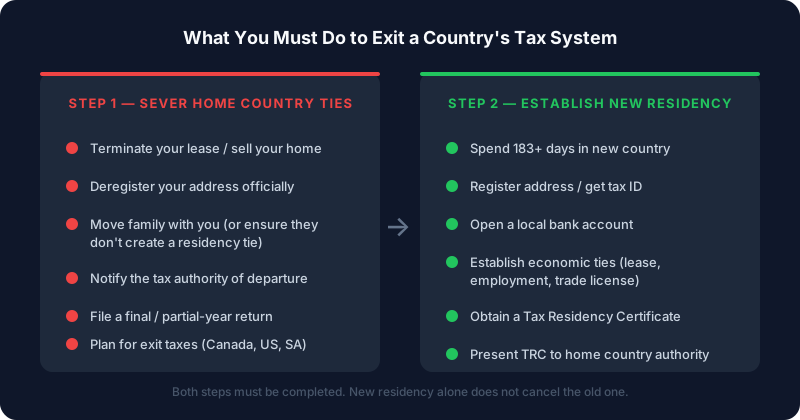
The Two Things You Must Do to Exit
Before getting into country-specific rules, there are two universal requirements:
1. Sever the ties that create residency in your home country. Different countries look at different factors — your permanent home, your family, your economic connections, how many days you spend there. You need to cut enough of these to fall below the threshold.
2. Establish residency somewhere else. This is not always legally required, but it is practically essential. Without a foreign tax residency certificate, your home country's tax authority has no reason to accept that you've left. Many countries explicitly require proof of new residency to process a formal tax exit.
Exit Rules by Country
Germany
Germany is one of the more straightforward countries to exit — if you do it properly.
What creates residency: Having a Wohnsitz (registered home) or your gewöhnlicher Aufenthalt (habitual abode — more than 6 months) in Germany.
How to exit:
- Deregister your address at the local Einwohnermeldeamt (registration office) — this is the Abmeldung form
- Terminate your lease or sell your property — you cannot maintain a home available to you in Germany
- Close or transfer German bank accounts (not legally required, but advisable)
- Notify the Finanzamt (tax office) of your departure
What can keep you resident: Keeping a room at a family member's home, maintaining a rented flat "just in case," retaining a German address on official documents. Even informal access to accommodation can qualify as a Wohnsitz.
Transition year: In your year of departure, you file a partial-year German tax return. Your worldwide income is not taxed — only German-sourced income from the period of residency.
France
France uses four independent tests for residency. If you meet any one of them, you remain French tax resident.
The four tests:
- Your foyer (family home) is in France
- Your principal place of stay is in France (183+ days)
- Your professional activity is in France
- Your center of economic interests is in France
How to exit: You must sever all four ties simultaneously. Moving abroad while your spouse and children remain in France means your foyer remains there — you stay resident. Moving your family abroad but keeping your main client base in France means your economic center remains — you stay resident.
Exit declaration: File a déclaration de départ with the Service des impôts des particuliers. Include your departure date and new foreign address.
Extended residency risk: France has an anti-avoidance rule — if you move to a country with a significantly lower tax rate and cannot show a genuine professional or personal reason for the move, French tax authorities may challenge the exit.
United Kingdom
The UK is one of the hardest countries to exit cleanly. The Statutory Residence Test (SRT) was specifically designed to prevent people from gaming a simple day-count rule.
What keeps you UK-resident after leaving:
- Spending too many days in the UK (the threshold depends on how many "ties" you retain)
- Retaining a UK home that is available to you
- Working in the UK (even part-time)
- Having a spouse or minor children remaining in the UK
- Having spent 90+ days in the UK in either of the previous two tax years
The "ties" system: The SRT uses a matrix of "ties" against days. If you have 4 ties, you become UK-resident after just 31 days in the UK per year. With 1 tie, you can spend up to 120 days. You need to know exactly how many ties you have and plan your days accordingly.
How to exit properly:
- Establish clear foreign residency before your UK departure date
- Reduce UK ties: sell your UK home, ensure your close family accompanies you or is already non-resident, limit working days in the UK
- Keep a written record of all days spent in the UK after your departure date
- File a Self Assessment return for your split year (HMRC's split-year treatment applies in most departure cases)
Tax year: The UK tax year runs April 6–April 5, not calendar year. Timing your departure around April 5 can significantly affect your tax position.
Australia
Australia applies a "resides" test with no fixed day threshold — which makes exit particularly uncertain. The ATO has historically been aggressive in challenging departures.
What creates residency: Living in Australia, having your "domicile" in Australia (where you have your permanent home), spending 183+ days in Australia, or being a member of certain government superannuation schemes.
How to exit:
- Establish that you have actually ceased to reside in Australia — not just visiting elsewhere
- Have a settled intention to live abroad (ideally evidenced by a foreign lease, foreign employment contract, or foreign residency permit)
- Terminate Australian accommodation or demonstrate it is genuinely not available to you
- Notify the ATO of your departure using the International tax — notify of departure process
The domicile test trap: Even if you stop residing in Australia, the domicile test can maintain your residency unless your "permanent place of abode" is demonstrably outside Australia. The ATO has argued that a person remains Australian-domiciled until they demonstrate a settled, long-term home elsewhere.
Superannuation: Leaving Australia doesn't allow you to access your superannuation unless you meet specific conditions (e.g., the Departing Australia Superannuation Payment for temporary residents). Don't count on accessing it as part of your exit.
Recommended approach: Request a formal private binding ruling from the ATO confirming your residency status if you have any doubt. This protects you from retrospective reassessment.
Canada
Canada uses a "residential ties" framework to determine residency. Exit requires severing significant ties — and the CRA is known for scrutinizing departures carefully.
Primary residential ties (most significant):
- A home in Canada (owned or leased)
- A spouse or common-law partner remaining in Canada
- Dependants remaining in Canada
Secondary residential ties (considered in aggregate):
- Canadian provincial health insurance coverage
- Canadian driver's licence
- Canadian bank accounts and credit cards
- Canadian club or professional memberships
- A Canadian passport
How to exit:
- Sever all primary ties — sell or genuinely surrender your Canadian home, ensure your family accompanies you
- File Form T1161 (departure return) for the year you leave
- File Form T1244 (election for deemed disposition) if you have significant assets — Canada deems you to have sold all your property on the date of departure (a "departure tax")
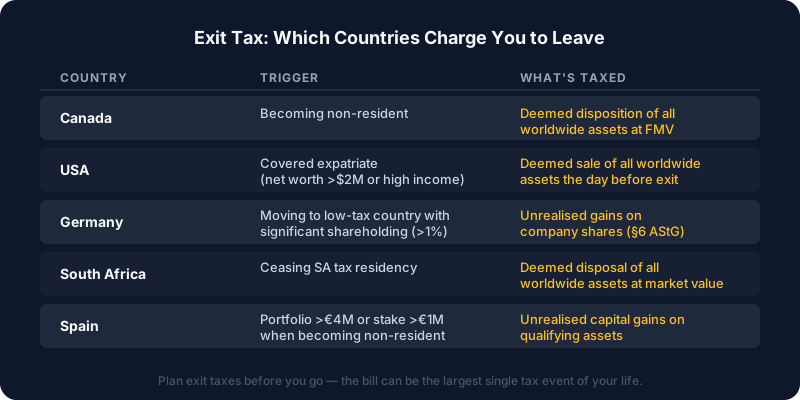
Deemed disposition: This is one of Canada's most significant exit traps. When you leave Canada, you are treated as having sold all your worldwide assets at fair market value on the day of departure. Capital gains tax applies on the deemed proceeds. For people with large investment portfolios or private company shares, this can be a substantial tax bill.
Netherlands
The Netherlands assesses residency based on all facts and circumstances — primarily where your "durable ties with society" are strongest.
How to exit:
- Deregister from the municipal population register (BRP — Basisregistratie Personen) at your local municipality
- Residency generally ends on the deregistration date
- File a partial-year return (M-form) for the year of departure
What the Dutch look at: Where your family lives, where you maintain a home, where you work, where your bank accounts are, where your children go to school. Deregistering is necessary but not always sufficient — if your life is still centered in the Netherlands, the tax authority may argue you remain resident.
Spain
Spain has a notable anti-avoidance provision: if you move to a country on Spain's "tax haven" list, you remain a Spanish tax resident for the tax year of your move and the following four years.
Countries on Spain's tax haven list (partial): Gibraltar, UAE, Cayman Islands, British Virgin Islands, Bermuda, Panama, Bahamas, Monaco. This effectively means that moving from Spain to the UAE for tax reasons doesn't work for five years.
How to exit (for non-haven countries):
- File Form 030 (change of tax address) notifying the AEAT of your departure
- Ensure you spend fewer than 183 days in Spain in the year of departure
- Your immediate family (spouse, minor children) must not remain primarily in Spain — this independently triggers Spanish tax residency regardless of your day count
- File a final income tax return (IRPF) for the partial year
Exit tax: Spain applies an exit tax on unrealized capital gains above €4 million (or €1 million for stakes in companies) when you become non-resident. This affects business owners and investors with significant holdings.
South Africa
South Africa has two separate but related processes: tax residency termination and financial emigration. They are not the same thing.
How to cease tax residency:
- Formally notify SARS (South African Revenue Service) that you have ceased to be a resident, using the relevant section of your annual return
- You must establish genuine residency elsewhere
- South Africa applies an exit tax: you are deemed to have disposed of all worldwide assets at market value on the date you become non-resident. Capital gains tax applies on the deemed gain.
Financial emigration (now: tax emigration): This is a separate process involving the South African Reserve Bank and your bank. It formalizes the conversion of your status from "resident" to "non-resident" in the South African financial system — necessary for moving funds out of South Africa freely. Since March 2021, financial emigration has been replaced by a simpler tax emigration process through SARS.
United States
The US deserves special treatment because it is categorically different from every other country on this list.
The fundamental problem: The US taxes based on citizenship, not residency. US citizens owe US tax on worldwide income regardless of where they live, no matter how many years they spend abroad, no matter which other countries they're resident in. There is no "exit" from the US tax system for citizens short of renouncing citizenship.
For green card holders: You can exit the US tax system by relinquishing your green card and ceasing to meet the Substantial Presence Test. However, if you held a green card for 8+ years ("long-term residents"), you are subject to the expatriation tax regime — same as for citizens who renounce.
The expatriation tax (Exit Tax): For citizens and long-term green card holders who expatriate, the US deems you to have sold all your worldwide assets on the day before expatriation. If you have a net worth over $2 million, or if your average annual net income tax over the prior five years exceeds a threshold ($201,000 for 2024), you are a "covered expatriate" and this exit tax applies in full.
For non-immigrant visa holders: Simply leaving the US and not meeting the Substantial Presence Test in future years ends your US tax residency. File a final Form 1040NR for the year of departure.
Other Countries: Key Exit Points
| Country | Exit mechanism | Notable trap |
|---|---|---|
| Italy | Deregister from AIRE (registry of Italians abroad) + local anagrafe | Failure to register in AIRE means you're presumed still Italian-resident |
| Sweden | Notify Skatteverket; "essential ties" test applies | A Swedish home available for use (even family-owned) maintains residency |
| Belgium | Deregister from commune; update National Register | Belgian tax authority scrutinizes deregistrations and can challenge based on "center of life" |
| Norway | Notify Skatteetaten; must be abroad for full calendar year | Residency doesn't end until January 1 of the year after you leave (if you left mid-year) |
| Denmark | Deregister from CPR; residence permit cancelled | Keeping a holiday home in Denmark can maintain Danish tax residency |
| Switzerland | Deregister from commune | Switzerland exits are generally clean; key issue is cantonal vs. federal rules |
| New Zealand | No formal process; IRD notified via departure return | "Permanent place of abode" in NZ can maintain residency even after leaving |
The Dual Residency Trap
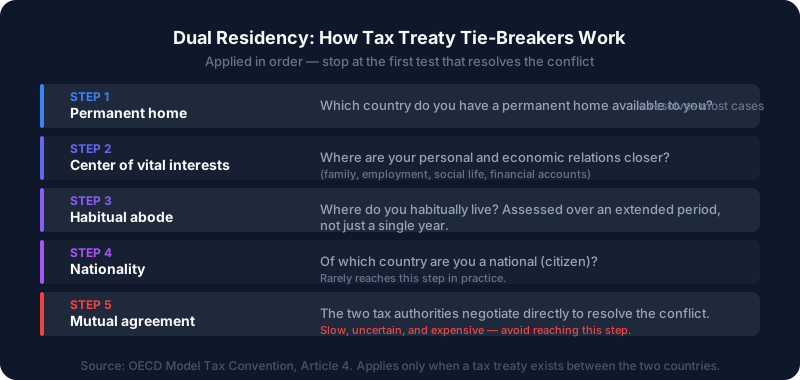
Even if you've exited your home country properly, you may temporarily be tax resident in both countries during your transition year. This is called dual residency and it's resolved by the tie-breaker rules in the tax treaty between those two countries (if one exists).
The OECD tie-breaker hierarchy (from Article 4 of the Model Tax Convention):
- Where is your permanent home?
- Where are your personal and economic relations closer?
- Where do you habitually abide?
- Of which country are you a national?
- Mutual agreement between the two tax authorities
If no tax treaty exists between your home country and your new country, both countries can tax you simultaneously — with no mechanism to resolve the conflict. This is a material consideration when choosing your destination country.
Common Exit Mistakes
1. Keeping a home "just in case." Even a spare room at a parent's house can constitute having a home available to you under some countries' rules. Either transfer or genuinely give up access.
2. Moving your money but not your life. Opening a bank account in a new country and moving funds there is not evidence of residency. It's tax residency that matters — and that requires physical presence, registered address, and economic ties.
3. Not getting a tax residency certificate from your new country. Your old country needs documentary proof that you've established residency elsewhere. A certificate of tax residency from your new country's tax authority is the gold standard.
4. Timing your exit mid-year without understanding partial-year rules. Many countries apply full-year worldwide taxation for the year of departure unless you formally establish a departure date. Leaving in November can mean your December income elsewhere is still taxable at home.
5. Ignoring exit taxes. Canada, South Africa, Germany, and the US all have versions of exit tax. For people with significant assets, this can be the largest tax bill of your life — and it needs to be planned for, not discovered after the fact.
How to Document Your Exit
Documentation matters because tax authorities assess residency retroactively. Build a file that includes:
- Deregistration confirmation from your home country's authorities
- Lease termination or property sale documents for your home country home
- Signed lease or property purchase documents in your new country
- A tax residency certificate from your new country's tax authority
- Bank account opening documentation in your new country
- Passport stamps or travel records showing physical presence in your new country
And once you've moved, use a Tax Residency Calculator to track your ongoing day counts in both your old and new countries. The last thing you want is to accidentally spend too many days back in your home country and inadvertently re-establish residency there.
Frequently Asked Questions
Do I need to notify my home country's tax authority when I leave?
In most countries — yes. Germany (Abmeldung), France (déclaration de départ), Canada (Form T1161), South Africa (SARS notification) all have formal exit processes. Even where not legally mandated, filing a final partial-year return and informing your tax authority creates a documented departure date.
What if I don't have a new country's residency yet when I leave?
This is a genuine risk period. Your home country may treat you as still resident until you establish residency elsewhere. A transitional period of up to 6 months while you establish new residency is generally manageable — but the longer the gap, the greater the risk.
Can I exit in one year and return the next without consequence?
Depends on the country. Some — like the UK under the SRT — have strict rules about returning to a country you recently exited. Spending too many days in the UK in the years following your departure can trigger UK residency again.
What if my spouse stays behind?
In France and Spain, a spouse remaining in your home country is a direct trigger for your continued residency there — regardless of where you are physically. In most other countries, it's a significant factor that weighs toward continued residency, even if not an automatic trigger.
Summary
Exiting a country's tax system is not passive — it requires deliberate action, documentation, and in some cases significant planning around exit taxes. Key takeaways:
- Most countries require a formal deregistration or notification process — not just physical departure
- Having a home available to you in your home country is the most common reason exits fail
- Canada, South Africa, Germany, and the US impose exit taxes on unrealized gains — plan before you go
- The US is fundamentally different: citizenship-based taxation means citizens cannot exit without renouncing
- A foreign tax residency certificate is your best evidence that you've genuinely left
- Track your days carefully on both sides of the move to avoid inadvertently re-triggering residency in your home country