
Georgia Tax Residency for Digital Nomads: 1% Tax, Virtual Zone, and Small Business Status
Georgia — the country, not the US state — has quietly become one of the most popular bases for digital nomads, remote workers, and location-independent entrepreneurs in the world. Tbilisi's tech scene, low cost of living, and visa-free access for most Western nationalities are part of the appeal. But the main draw is the tax system.
Georgia offers an unusually favorable set of tax options for foreign-sourced income earners. Depending on how you structure your activities, your effective Georgian income tax rate can be as low as 1% — legitimately, with full compliance.
This guide covers how Georgian tax residency works, the 183-day rule, the two main tax optimization structures (Small Business Status and the Virtual Zone), and how to set things up practically.

How Georgian Tax Residency Works
Georgia determines tax residency primarily through physical presence.
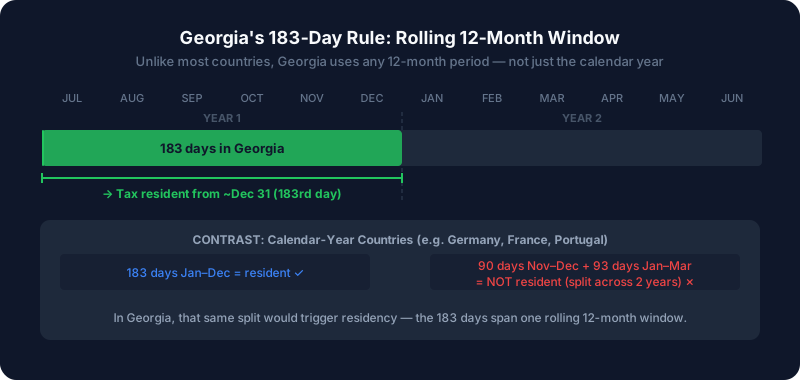
The 183-day test: If you spend 183 days or more in Georgia during any consecutive 12-month period (not necessarily a calendar year), you are a Georgian tax resident.
This is an important distinction from most countries: Georgia uses a rolling 12-month window, not a calendar year. If you arrive in Georgia on July 1, 2025 and are still there on December 31, 2025, that's only 184 days — but those days count toward the 12-month window beginning July 1, 2025. You would be considered resident from around December 31, 2025.
Alternative tests: Georgian tax law also recognizes residency based on having a permanent home in Georgia, or having your center of vital interests in Georgia. But the 183-day test is the primary and most commonly applied test.
What Georgian residency means for taxes: Georgia taxes residents on Georgian-sourced income at standard rates. Foreign-sourced income is handled differently depending on your status — which is where the planning opportunities lie.
Georgia's Tax Rates (Without Special Status)
For a Georgian tax resident without a special regime:
| Tax | Rate |
|---|---|
| Personal income tax | 20% |
| Corporate income tax | 15% (on distributed profits only) |
| Dividend tax | 5% |
| Social security contribution | 2% (employee) + 2% (employer) — voluntary for self-employed |
| VAT | 18% (registration threshold: GEL 100,000/year) |
At 20% income tax, Georgia is not automatically a low-tax country. But two specific structures — Small Business Status and the Virtual Zone — dramatically reduce that burden for qualifying individuals.
Structure 1: Small Business Status (1% Tax)
This is the most widely used structure by foreign freelancers and remote workers in Georgia.
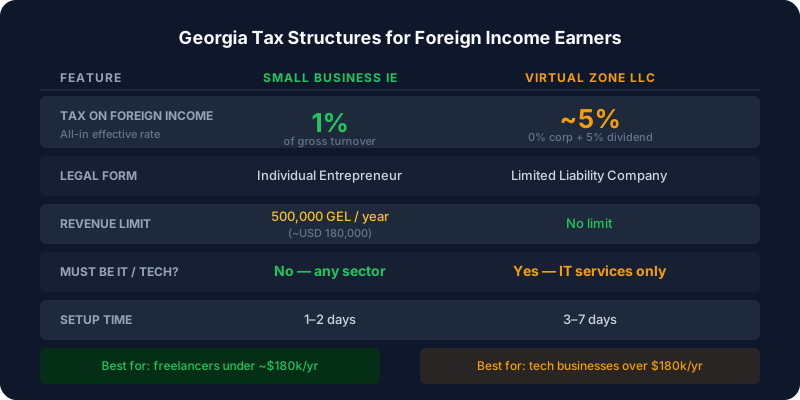
What it is: An Individual Entrepreneur (IE, or Индивидуальный предприниматель in Georgian bureaucratic practice) registered in Georgia can apply for Small Business Status — a special tax regime under Georgian tax law that taxes turnover at just 1% (instead of the standard 20% income tax), provided annual turnover does not exceed 500,000 GEL (approximately USD 180,000 at current rates).
Who can use it:
- Individual entrepreneurs (not companies — this is a personal registration)
- Any type of business activity except those explicitly excluded (see below)
- Both Georgian residents and non-residents who earn Georgian-sourced income — but practically, it's most useful for residents
What's excluded from Small Business Status:
- Activities requiring a license (banking, insurance, financial services, etc.)
- Legal services (advocates/lawyers)
- Consulting services to related parties
- Any activity the Georgian Revenue Service determines is conducted as an employee relationship rather than genuine entrepreneurship
The 1% rate applies to gross turnover — there are no deductible business expenses under this regime. At 1%, this typically makes sense for service businesses with high margins. If you have significant costs, the alternative of registering as a standard IE (and deducting expenses against the 20% rate) might result in lower actual tax.
When the rate increases to 3%: If your annual turnover exceeds 500,000 GEL, the Small Business Status is revoked for that year and you are taxed at 3% on total turnover for the year (with an option to switch to the standard 20% on profits if that is lower).
Structure 2: Virtual Zone IT Company (0% on Foreign Revenue)
For technology and software businesses, Georgia offers an even more favorable regime: the Virtual Zone.
What it is: A Georgian limited liability company (LLC, called SHpS in Georgia) that is registered as a Virtual Zone entity pays 0% corporate income tax on revenue earned from clients outside Georgia — provided that revenue is from the sale of IT products and services.
Who it's for: Software developers, IT service companies, SaaS businesses, app developers, cybersecurity firms — any tech business whose clients are primarily outside Georgia.
The 0% applies to: Revenue from the sale or delivery of IT products and services to non-Georgian clients. "IT products and services" is defined in Georgian law and broadly covers software development, IT consulting, cloud services, app development, data processing, and related activities.
The standard rates still apply to: Any Georgian-source revenue (local clients), non-IT revenue, dividends distributed to shareholders (5% dividend tax), and individual income of the company's owner if they take a salary.
The owner's salary question: If you are the sole owner and director of a Virtual Zone company and you take a salary from it, that salary is personal income taxed at 20% (as a Georgian resident) or the relevant non-resident rate. Many practitioners structure this as a minimal salary plus distributions — but dividend distributions from a Virtual Zone company are subject to 5% withholding tax (reduced from the standard corporate rate, but not zero).
In practice: A Georgian LLC with Virtual Zone status, earning revenue from non-Georgian tech clients, pays effectively 0% corporate tax at the entity level. The owner then pays 5% on dividends when taking money out. Total effective rate on foreign tech revenue: ~5%.
Combining the Two: Which Structure Is Right?
The choice between Small Business Status (IE, 1% on turnover) and a Virtual Zone company (LLC, 0% corporate + 5% dividend) depends on your income level, business type, and how you want to use the money.
| Small Business IE | Virtual Zone LLC | |
|---|---|---|
| Legal form | Individual entrepreneur | Limited liability company |
| Tax on foreign tech revenue | 1% of turnover | 0% corporate tax |
| Tax on personal distributions | Included in IE income | 5% dividend withholding |
| Effective rate (all-in, foreign income) | ~1% | ~5% |
| Revenue threshold | 500,000 GEL / year | No threshold |
| Suitable for | Low-to-medium income freelancers | Higher income, IT businesses |
| Setup complexity | Simple — 1 day process | Moderate — company registration |
| Must be IT/tech? | No | Yes |
For most freelancers and remote workers earning under USD 150,000/year: Small Business IE with 1% tax is the simpler, cheaper, and more flexible option.
For tech business owners earning more than USD 150,000/year (or approaching the 500,000 GEL threshold): A Virtual Zone LLC at ~5% all-in is worth the added complexity.
How to Register as a Small Business IE in Georgia
Georgia's business registration process is genuinely fast and simple — this is one of the country's standout advantages.
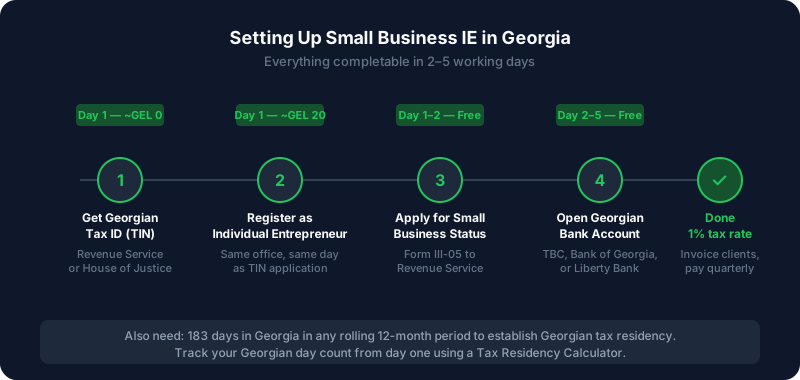
Step 1: Get a Georgian tax ID (TIN)
Obtain a TIN at a Georgian Revenue Service office or House of Justice (Sakhalkho sakhli). You'll need your passport. Takes 1 day or less.
Step 2: Register as an Individual Entrepreneur
At the same Revenue Service office or House of Justice, submit a registration form for IE status. This can often be completed on the same day as your TIN application. Cost: approximately GEL 20.
Step 3: Apply for Small Business Status
Submit Form III-05 to the Revenue Service declaring your application for Small Business Status. This is processed quickly and confirms your 1% rate.
Step 4: Open a Georgian bank account
TBC Bank, Bank of Georgia, and Liberty Bank are the main options. Opening a business account as an IE requires your passport, TIN, and IE registration certificate. Allow 1–5 days.
Step 5: Start issuing invoices and keeping records
Issue invoices from your IE to your foreign clients. Maintain records of income. File quarterly tax returns and pay 1% quarterly.
Total setup time: Most people complete everything within 2–5 working days if documents are in order.
The Remotely From Georgia Program
Georgia offers a specific program for remote workers wanting to spend time in the country without committing to full residency: Remotely From Georgia.
This allows citizens of 95 countries to stay in Georgia for up to 1 year while working remotely. It's not a visa — it's an extension of the existing visa-free access that most Western nationalities already have.
For nomads who want to spend 3–6 months in Georgia (staying under the 183-day threshold), Remotely From Georgia means no visa bureaucracy and no tax residency implications. You simply arrive, work, and leave before 183 days.
For those who want to establish Georgian tax residency and use the 1% or Virtual Zone structures, you'd need to stay past 183 days and follow the registration steps above.
Georgia's Double Taxation Treaty Network
Georgia has double taxation agreements with over 55 countries, including Germany, France, Netherlands, UK, Austria, Czech Republic, Ukraine, China, and many CIS countries.
Notable absences: Georgia does not currently have tax treaties with the US, Canada, or Australia. For citizens of those countries, the absence of a treaty means potential double taxation if your home country also asserts taxing rights over your income.
US citizens in Georgia: The US taxes its citizens on worldwide income regardless of residence. Living in Georgia with Small Business Status does not reduce US tax obligations. The Foreign Earned Income Exclusion (FEIE) may offset some of this, but US expats in Georgia need specialist US tax advice.
Practical Considerations for Living in Georgia
Cost of living: Tbilisi is one of the most affordable capitals in Europe-adjacent geography. A comfortable one-bedroom apartment in a good neighborhood runs USD 500–900/month. Restaurants, transport, and utilities are significantly cheaper than Western Europe.
Internet and coworking: Connectivity in Tbilisi is generally strong. Multiple coworking spaces exist, with prices that are a fraction of equivalents in Lisbon or Berlin.
Banking: Georgian banks accept foreign clients, though some foreign banks and payment processors have restrictions on Georgian-registered companies. Wise (TransferWise) and Revolut work well for receiving payments; local Georgian banks handle GEL transactions. Getting EU/US payment processing for a Georgian LLC can require additional structuring.
Community: Tbilisi has one of the largest digital nomad communities in the world relative to its size. The expat community is well-connected and resources for navigating Georgian bureaucracy are readily available through local Facebook groups and forums.
Frequently Asked Questions
Can I use Small Business Status if I'm not a Georgian tax resident?
Technically, non-residents can register as IEs and use Small Business Status for Georgian-sourced income. But the practical benefits are mostly relevant for Georgian residents who are earning foreign-sourced income. If you're not resident, the interaction with your home country's tax rules is the main consideration.
What if I spend less than 183 days in Georgia?
If you're under 183 days in any 12-month period, you're not a Georgian tax resident. You can still register as an IE and operate under Small Business Status — but whether that income is taxable in Georgia (at 1%) or in your home country depends on your specific situation and applicable treaties.
Is the 1% tax legally solid, or is it a grey area?
It's explicitly provided for in Georgian tax law (Chapter XIV of the Tax Code of Georgia). It is not a loophole — it is a deliberate policy to attract entrepreneurs to Georgia. The structure is widely used, acknowledged by the Georgian Revenue Service, and not considered aggressive tax planning.
Can I keep my home country bank account while being a Georgian IE?
Yes. There's no requirement to use only Georgian bank accounts. Many Georgian IEs receive payments in EU or US bank accounts. You should ensure payment flows are properly documented and that you're filing correctly in Georgia.
Does Georgia have CRS reporting?
Yes. Georgia joined the Common Reporting Standard in 2019 and automatically exchanges financial account information with partner countries. If you have a Georgian bank account, your home country's tax authority may receive information about it.
Summary
Georgia is one of the most genuinely tax-friendly residency options available to digital nomads and remote workers — and unlike some alternatives, the tax benefits are created by explicit law, not grey-area planning.
- Georgian tax residency is established at 183 days in any rolling 12-month period
- Small Business IE status taxes foreign-sourced income at 1% of turnover (up to ~USD 180,000/year threshold)
- Virtual Zone LLC status taxes foreign IT/tech revenue at 0% corporate tax (plus 5% dividend tax on distributions)
- For most freelancers: Small Business IE is simpler and sufficient
- For higher-income tech businesses: Virtual Zone LLC is more efficient
- Registration is fast — often completable in 2–5 working days
- Georgia has a growing double taxation treaty network but notably lacks treaties with the US, Canada, and Australia
- Track your Georgian day count carefully — the 183-day threshold uses a rolling 12-month window, not a calendar year